
Designing hotels that feel alive
Studio Collective’s Adam Goldstein on designing feeling
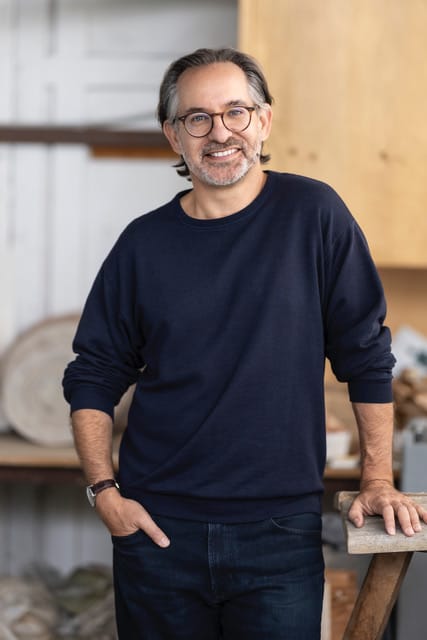
Grounded in place and deeply tactile, Studio Collective’s hospitality work treats hotels as living environments rather than static spaces. Co-founder Adam Goldstein brings a multidisciplinary background in architecture, interiors and brand storytelling and focuses on flow, texture, light and atmosphere alongside the aesthetics.
Here, he shares how creative influences show up in his work and why hospitality has the power to transport people out of their day-to-day existence.
—Interview by Jennifer Glatt, edited by Bianca Prieto
Everyone has a space that teaches them something. What’s one room—past or present—where you immediately felt, “This is how I want people to feel in the spaces I design,” and what about that moment has stayed with you?
I went to school for architecture and sort of stumbled my way into interiors. While still in grad school, I got a part-time job working for Kelly Wearstler. This was just prior to her becoming the world-renowned designer she is today, and shortly after I started, she was finishing up work on the boutique hotel Maison 140. It’s this small, dark, moody hotel on a side street in Beverly Hills, and I just remember walking through the front doors for the first time during the install and thinking I had walked onto a film set. I think that’s when I had the “lightbulb moment” realization that hospitality really does have the power to transport people out of their day-to-day existence to someplace totally different and unexpected.
If your personal creative “compass” had a north star outside of design (a musician, a filmmaker, a city, even a childhood memory), what would it be and how does it quietly show up in your work?
It would be more of a constellation than a star, as there are so many people and places that influence our work on a daily basis. The first one that comes to mind for me is Gary Clark, Jr. He creates the most soulful music and pulls the music out of his guitar with such ease, all while making it seem totally effortless. I am not only a huge fan of his music, but I love the illusion of how easy he makes it all seem. I think there is something to be said for letting people just experience our spaces without having to fully reveal all the blood, sweat and tears that go into each project.
Independent hotels often strive for a sense of “place,” but that can quickly turn into caricature. Can you recall a recent moment when you deliberately removed a hyper-local design element because it felt too easy—and what you replaced it with to create something more emotionally resonant than literal?
As we control the design narrative from the outset of the project, I can’t think of a specific instance where we had to remove anything, as we are the ones responsible for placing them to begin with. We are very cognizant of ensuring that our projects do not become overly thematic. One way in which we try to infuse local character is to work closely with local artists and craftspeople to lend their expertise to the projects. Most recently, we worked with Rebecca Sheedy of FloraForm Design to create a beautiful, double-height living wall at the entrance to our 1 Hotel Seattle project. Her creativity and artistry far exceeded anything we could have dreamt up.
Studio Collective’s projects often balance elegance with a certain looseness or patina. Can you describe a time when an imperfection ended up shaping the entire narrative of a project?
That was basically our whole concept for Hotel Figueroa. It is such an incredible property that has lived so many lives over the years, starting as a YWCA in 1926. When we first met with ownership, our pitch was to strip back all the layers of paint and light renovations it had received and try to highlight the original architecture as much as possible, adding that anything new should feel like it was of the current time and not a historical recreation. As a result, we maintained broken entrance way pediments, restored a ground floor coffin-shaped swimming pool and used a guest room floor plate made up of 35 different room types. Had we started from scratch, the entrances would have been relocated, the pool would have been put on the roof and the floor plans would have been redone to maximize efficiency; however, these and countless other details are what make Hotel Fig such a special project.
If an independent hotel could have one “secret ingredient” that guests never consciously notice but always feel, what should it be—and how do you design for it without over-engineering the magic out of it?
I feel like independents’ “secret ingredient” is just that—their independence. No brand standards. No chain of command approval process. No red tape. It’s something which is very tangible to us as designers, but to guests who are not as familiar with how hotels operate, it might be a little less obvious. Designers should embrace the freedom to reflect these property’s independent spirit and operators should allow for the flexibility to evolve over time and to meet guests where they are.
From a design perspective, I feel like once something is “documented,” it loses a little of its soul, so just allowing yourself to sprinkle a bit of the unknown into projects and trusting that the right piece will reveal itself when the time comes is invaluable. Luckily, my partner Leslie Kale is a true magician when it comes to that last part.
Independent owners often have strong personalities and strong opinions. What’s the most unexpected client request you’ve ever found a way to honor, and how did that reinterpretation ultimately influence the guest experience?
I don’t know, maybe we have been lucky, but our partners have more or less trusted us when it comes to the design (provided it comes in at budget and on time). Any client requests that we thought were not fitting with the overall design direction, we have been able to discuss and either find alternatives that the client signed off on, or even change their mind.
We had one client who was a bit more conservative in their tastes and when looking for art for the project, I recall him telling us he was not a fan of abstract paintings or “anything that looked like his child could paint it.” I gently reminded him that it’s not about what he likes or what I like, but really what will serve the project best, and he eventually came around on his perspective.
Thanks for reading today's edition! You can reach the newsletter team at newsletter@mintpillow.co. We enjoy hearing from you.
Interested in advertising? Email us at newslettersales@mvfglobal.com
Mint Pillow is curated and written by Jennifer Glatt and edited by Bianca Prieto.